Who is the world’s greatest all-round mind sports player?
Unlike a traditional world championship, the Pentamind rewards versatility. Competitors score points across five different events, testing not only excellence but adaptability. Over the years, champions have emerged from backgrounds as diverse as chess, backgammon, poker, Scrabble, abstract strategy games, puzzles, card games and much more.
Yet hidden among nearly three decades of Pentamind history is a remarkable coincidence.
The Curious Case of the Hs and Ks
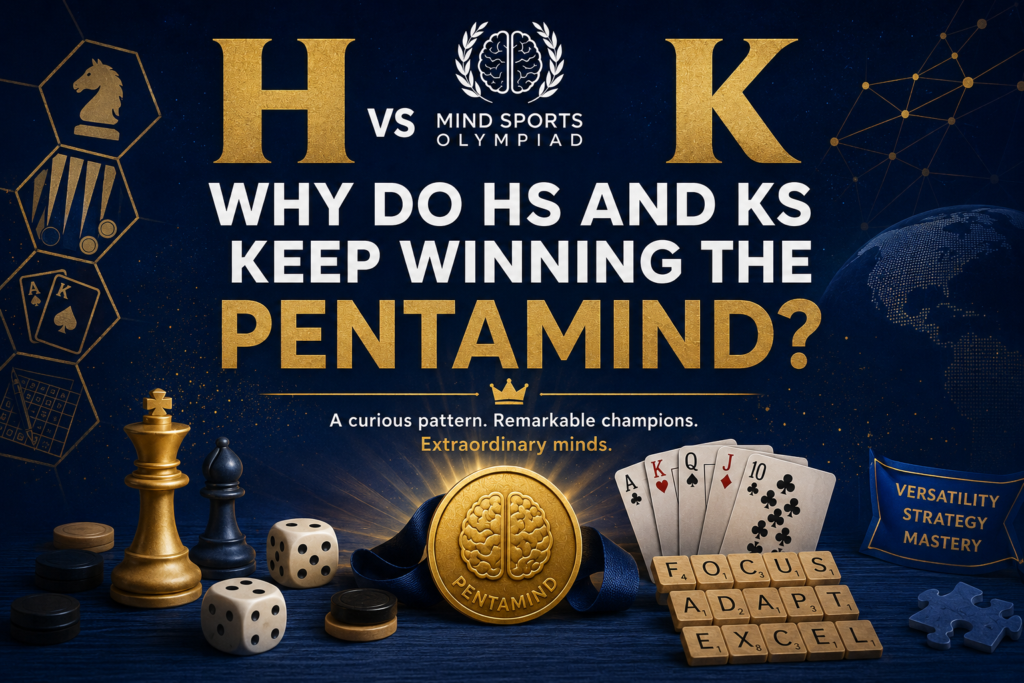
In 20 of the 29 Pentamind World Championships, the winner has had a surname beginning with either H or K.
Even more remarkably, seven of the last eight championships have been won by a player with the initials A.K.:
- Ankush Khandelwal – 2018, 2019, 2020, 2023
- Andres Kuusk – 2022, 2024, 2025
Between them, Ankush Khandelwal and Andres Kuusk have won 12 Pentamind titles—more than 40% of all championships ever held!
The Hs: From a Nobel Prize to the Pentamind
No surname has shaped the Pentamind quite like Hassabis. Long before founding DeepMind, before AlphaGo defeated Lee Sedol and transformed artificial intelligence, and before receiving the 2024 Nobel Prize in Chemistry, Sir Demis Hassabis won the Pentamind five times, a record that stood for many years.
Looking back, those victories seem almost prophetic.
The Pentamind rewards the ability to learn new games rapidly, recognise patterns across different domains and transfer knowledge from one discipline to another. In retrospect, the Pentamind almost feels like a proving ground for the kind of general intelligence Hassabis would later pursue at DeepMind—not mastery of one game, but the ability to transfer knowledge across many different domains. Long before AlphaGo or AlphaFold, Hassabis was already asking a similar question through games: what does it take to master not one domain, but many?
🎓 Watch Demis Hassabis’s Nobel Prize speech here: https://www.youtube.com/watch?v=YtPaZsasmNA
Demis wasn’t the only remarkable H.
James Heppell became Pentamind World Champion in 2015 and 2017, establishing himself as one of the great all-round competitors of the modern era. A former England junior chess international with a PhD in Complex Systems Simulation, James became the central figure in our documentary, Pentamind: The Ultimate Mind Sport Championship, which follows his quest to become the world’s greatest all-round games player.
🎬 Watch the documentary here: https://www.youtube.com/watch?v=PpXHJpxQRJ0
The Hs also include two of Britain’s most versatile competitors. Martyn Hamer, who shared the 2009 Pentamind title, has enjoyed success across an astonishing range of disciplines. Alongside major backgammon victories, many UK viewers will recognise him from ITV’s The Chase, a fitting stage for someone whose breadth of knowledge mirrors the spirit of the Pentamind itself. Meanwhile, Tim Hebbes won the Pentamind outright in 2005 before sharing the title with Hamer in 2009, making him one of the select group of multiple Pentamind champions.
The Ks: The Modern Dynasty
If the Hs defined the early decades of the Pentamind, the Ks have dominated the current era — and fittingly, the dynasty began with a shared crown. In 2013, Ankush Khandelwal and Andres Kuusk tied for the Pentamind title, the two men who would go on to define the modern age of the competition standing side by side.
Ankush Khandelwal is a five-time Pentamind World Champion (2013, 2018, 2019, 2020 and 2023) and one of the most complete games players in the world. A master chess player, an accomplished bridge player and a professional poker player, the former trader seems able to learn any game put in front of him — and then win at it. Calm under pressure and consistently excellent across an extraordinary range of events, he has become one of the defining competitors of his generation.
Alongside him stands Andres Kuusk, whose achievements have elevated the Pentamind to new heights. The Estonian economist and data scientist became the first seven-time Pentamind World Champion (2011, 2013, 2014, 2016, 2022, 2024 and 2025), surpassing Demis Hassabis’s long-standing record. His consistency across such a diverse range of games is arguably unmatched in the history of the competition.
This year, Andres added another accomplishment by publishing Unlocking the Success Puzzle, a fascinating exploration of decision-making, learning and performance, drawing on lessons from both elite competition and professional life. Between them, Ankush and Andres hold twelve Pentamind titles. Since 2013, only three other players have won the championship at all.
The One Exception
In the middle of the modern A.K. era came Maciej Brzeski. Winning the Pentamind during the challenging pandemic edition of 2021, Maciej demonstrated remarkable versatility in an unprecedented online competition.
Away from the board, Maciej is a mathematician and AI researcher. Based in Cracow, he completed a PhD in Computer Science and now works as a Senior AI Research Engineer at Salesforce. Maciej’s day job is spent teaching machines to reason about complex systems, while his weekends are spent out-reasoning humans across the games table. Since then, he has gone from strength to strength, becoming one of the most consistent performers on the Mind Sports Olympiad circuit and dominating many of the Grand Prix standings.
What Makes a Pentamind Champion?
Looking through the list of champions, one thing becomes clear. They hail from a range of games such as chess, bridge and backgammon, but have been driven by curiosity to learn and master new games. They are scientists, software engineers, economists, traders, television quiz stars and professional game designers. What unites them isn’t mastery of a single game, but an extraordinary capacity to learn, adapt and excel across many different challenges.
Perhaps that’s why so many Pentamind champions have gone on to achieve remarkable success outside the competition as well. With 20 of the 29 championships carried off by an H or a K — and seven of the last eight won by an A.K. — the question hanging over this year’s Pentamind is a simple one: can anyone else write their initials into the next chapter of Pentamind history?



0 Comments
Leave A Comment